
In modern building systems, aluminum profiles have become the mainstream material for doors, windows, curtain walls, decorative cladding, structural support, and more. From low-rise residences to supertall landmarks, from commercial buildings to public venues, the application scenarios for aluminum profiles continue to expand. This is not an industry trend-following, but rather a result of their material properties and process advantages that comprehensively meet the core demands of modern architecture.
I. Lightweight Yet High-Strength, Reducing Building Structural Load
The core advantage of aluminum profiles lies in their excellent strength-to-weight ratio. Their density is only one-third that of steel, but their specific strength (strength-to-density ratio) outperforms ordinary carbon steel, allowing for significant weight reduction under the same load-bearing requirements.
When applied to building facades and envelope structures, they can significantly reduce the vertical load on the main building structure, cutting material input and construction costs for foundation works. In supertall buildings, the lightweight feature effectively reduces structural self-weight and seismic response, enhancing overall building safety-which is also the core reason why high-rise curtain walls widely adopt aluminum profiles.
II. Weather and Corrosion Resistance, Extending Full Life-Cycle Service Life
Aluminum naturally generates a dense oxide protective film on its surface, providing inherent rust and corrosion resistance. When paired with surface treatments such as powder coating or fluorocarbon (PVDF) spraying, weather resistance is further enhanced. Under normal outdoor conditions, the service life can reach 15–20 years, and high-end projects using premium PVDF coatings can extend this to 20–25 years.
Compared to the shortcomings of steel (prone to rust) and wood (prone to decay and cracking), aluminum profiles can withstand long-term exposure to sunlight, rain, and salt spray. In coastal and industrial pollution areas, their maintenance costs can be 40%–60% lower than those of steel, significantly reducing the operational and maintenance investment throughout the building's life cycle.
III. Design Flexibility, Adapting to Diverse Architectural Forms
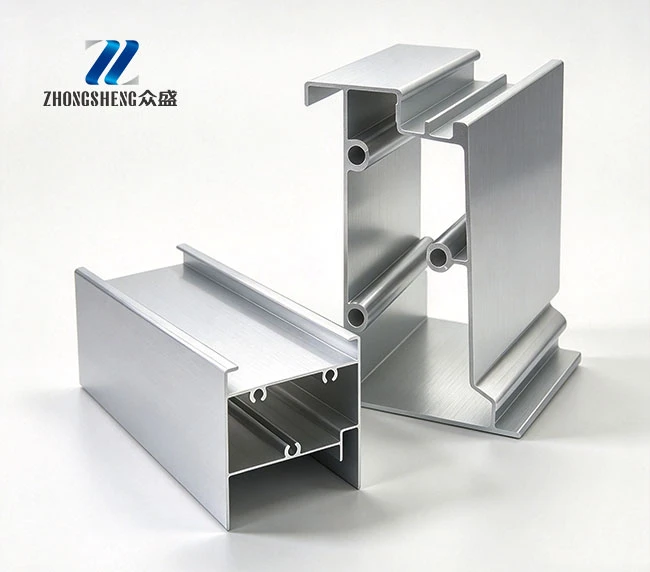
The extrusion process gives aluminum profiles a high degree of design freedom, allowing the production of any cross-sectional shape through custom molds. Multiple functional structures such as card slots, stiffeners, and sealing grooves can be integrated, achieving one-time forming without secondary processing.
Whether it's simple straight profiles or special shapes like arcs and irregular forms, they can be precisely realized to fully match the architect's design expression. At the same time, the rich colors of surface treatments can adapt to different architectural styles, from modern minimalism to distinctive textures, making them an important medium for facade design.
IV. Energy Efficiency and Recyclability, Aligning with Green Building Trends
In the field of building energy efficiency, aluminum profiles perform exceptionally well. Thermal-break aluminum profiles paired with insulated glass can effectively block heat and cold transfer, reducing building heating and cooling energy consumption, making them standard components of energy-efficient buildings.
At the same time, aluminum is a metal material that can be infinitely recycled. Remelting recycled aluminum requires only about 5% of the energy needed to produce primary aluminum. The recycling rate of aluminum profiles in the construction sector can reach 92%–98%, and the performance does not degrade after recycling. This characteristic fully aligns with the development direction of circular economy and low-carbon initiatives, serving as a significant plus factor in green building certifications.
V. Prefabricated Construction, Improving Construction Efficiency
Aluminum profiles can be standardized and prefabricated in factories with high dimensional accuracy. On-site work only requires bolt splicing and assembly, eliminating the need for welding and wet trades.
Compared to traditional welding and wet trade methods, this dry construction approach can shorten the construction period by over 30%, reduce on-site dust, noise, and construction waste emissions, fully aligning with the development direction of prefabricated buildings. At the same time, the light weight of the components makes transportation and installation convenient, reducing the difficulty and safety risks of on-site construction.
From structural performance and service life to design adaptability and environmental friendliness, aluminum profiles comprehensively meet the development needs of modern architecture. As building quality and energy-saving requirements continue to rise, their application share in the construction industry will further expand.