


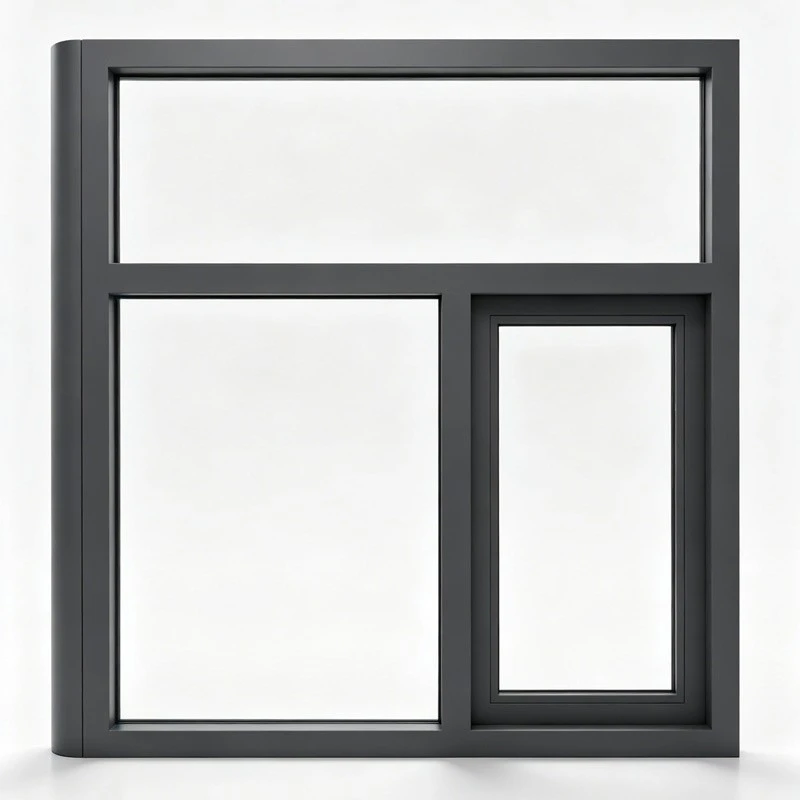
Renqiu Zhongsheng Metal Products Co., Ltd. is one of the most professional manufacturers and suppliers of pvc fire-resistant window in China. Please feel free to wholesale durable pvc fire-resistant window made in China here from our factory. All customized products are with high quality and low price. Contact us for pricelist.

Modern overseas civil building design has moved beyond simply pursuing high fire safety performance. More projects, while meeting local fire regulations, place great emphasis on the energy-saving properties, aesthetic uniformity, and long-term economic efficiency of windows and doors. Traditional metal fire-resistant windows offer high hardness and strong protection, but generally suffer from poor insulation, heavy weight, and a harsh appearance, making them unsuitable for residential buildings, schools, hospitals, and other buildings where a comfortable living experience is paramount. The emergence of PVC fire-resistant windows fills this market gap, becoming the mainstream choice for lightweight fire-resistant exterior wall projects.
Comprehensive Performance Advantages
High Cost-Effectiveness
Compared to aluminum alloy fire-resistant windows and PVC fire-resistant windows, PVC fire-resistant windows have a lower overall cost, making them suitable for residential projects that require a balance between safety and comfort.
Insulation and Soundproofing
Inheriting the excellent insulation, soundproofing, and noise reduction properties of PVC windows, they effectively solve the problem of traditional fire-resistant windows failing to achieve energy-saving insulation in buildings.
Uniform Appearance
It can maintain the same style and color as ordinary residential windows, avoiding the bulky appearance and aesthetic impact on building facades of traditional fire-resistant windows.
Advantages
Essentially, it strikes a middle ground between ordinary PVC/steel fire-resistant windows. Here are a few concrete points:
Good Thermal Performance, No Cold Bridges
PVC/engineering plastic profiles have low thermal conductivity. Combined with multi-cavity structures and steel reinforcement, they don't freeze in winter or get too hot to the touch in summer. They are easier to pass green building/energy-saving inspections than steel frames, eliminating the need for additional insulation patches.
Colorable Exteriors, One-Piece Molding
The surface is co-extruded or film-coated, eliminating the need for on-site painting. The color matches ordinary residential PVC/steel windows, making it much more aesthetically pleasing than black steel windows.
Corrosion and Rust Resistance
The plastic substrate is resistant to salt spray. Even when shipped to coastal areas, there's no need to worry about rust spots on the steel frame. As long as the packaging protects against impacts, the appearance will be generally stable upon arrival at port.
This product is lightweight and easy to install
Significantly lighter than steel fire-resistant windows of the same size, it's easier for workers to carry when installing on exterior walls of high-rise buildings or in large-scale batches. The anchoring requirements for auxiliary materials are also much lower than with steel.
It meets the requirements for fire-resistant partitions on exterior walls
A flame-retardant system is added to the standard formula, and when paired with single-pane cesium potassium/Class C fire-resistant glass, it generally achieves 0.5 hours (Class C) or 1.0 hour (Class B) fire resistance integrity, sufficient for exterior windows and inter-floor fire separation in high-rise residential buildings.
Mature connection points
Existing PVC system hardware can be used; as long as a continuous steel lining is added internally and high-temperature resistant anchors are used, the modifications are not significant, and the threshold for mass production in factories is lower than for entirely new steel systems.
The development history of PVC fire-resistant windows has evolved alongside the upgrading of building fire protection and energy-saving standards. Originating in Germany in the late 1950s, it was introduced to my country in the early 1980s with only basic insulation functions. Although it experienced explosive growth in the 1990s, vicious industry competition and shoddy workmanship led to safety hazards such as easy aging and low strength. With the widespread use of modern exterior wall insulation materials, traditional fire-resistant windows can no longer meet the energy-saving requirements of buildings. PVC fire-resistant windows have emerged and undergone technological advancements: by optimizing the multi-cavity structure, adopting fiberglass reinforcement materials, and innovating aluminum-plastic composites, they have successfully overcome early shortcomings. Today, with their high cost-effectiveness and excellent thermal and sound insulation performance, they perfectly meet the dual standards of "fire safety" and "green energy saving" for modern high-rise residential buildings.
Hot Tags: pvc fire-resistant window, China pvc fire-resistant window manufacturers, suppliers


